Tampa Bay's Trusted Fiberglass Pool Builders


Durable Pool Deck Pavers in Tampa Bay, FL
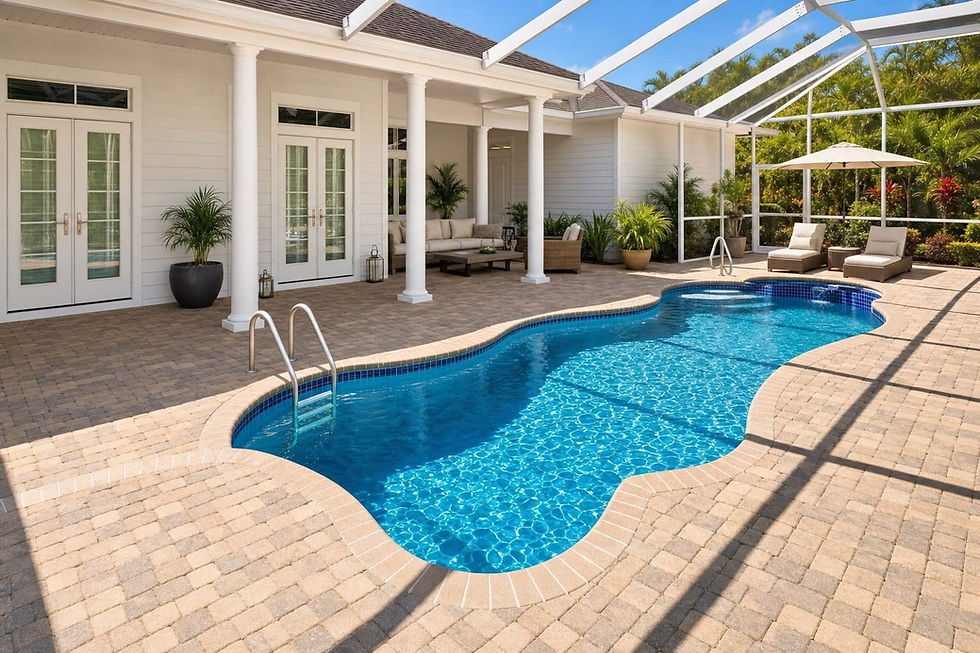
Hawaiian Island Pools provides paver pool deck installation in Tampa Bay, FL alongside our fiberglass pools, so the deck and the pool come together on one build schedule. We work across the region from our office in New Port Richey.
Why Pool Decks Fail in Tampa Bay Backyards
Many deck problems around Tampa Bay pools start below the surface, where sandy soil meets heavy afternoon storms.
The Tampa Bay area gets roughly two-thirds of its yearly rain between June and September, and Tampa recorded its wettest rainy season on record in 2024 at 51.87 inches. Stormwater runs to the lowest ground, which is often the deck edge or the base of a screen enclosure. Florida's sandy soil also shifts, and rigid concrete cracks under that movement. It is the reason we install only fiberglass pools in Florida, and it shapes how a pool deck should be built.
Cracked poured slabs.
A solid concrete deck has little room to flex, so settlement in sandy fill often shows up as cracks.
Ponding at the screen line.
Water that sits against the enclosure base softens the soil underneath and leaves the surface damp and stained.
Washed-out joints.
Joint sand that drains away leaves pavers loose and rocking underfoot.
Lifted coping.
Movement at the pool edge pushes coping stones out of line with the deck.
Trip edges near the water.
One sunken row beside the coping becomes a hazard for wet, bare feet.
Paver Pool Deck Installation in Tampa Bay, FL Built for Storm Season
A paver deck holds up in this climate when the slope, the base, and the edges are right before the first paver goes down.

Slope That Sheds Stormwater
A paver deck should slope slightly away from the pool and the house, so rain runs off the surface instead of collecting on it. Few details affect how a deck holds up through a Florida August more than that grade. On a flat yard, deck drains or a shallow swale can carry water past the screen line.

Compacted Base and Bedding Layer
A solid pool deck sits on a base compacted in layers, topped with a level bedding course of sand that sets each paver at the right height. A thin or loose base is a common reason pavers sink over time.

Edge Restraint and Joint Sand
Edge restraint along every open side keeps the field locked in place, and swept joint sand, often polymeric, helps the pavers carry load together. Interlocking pavers tolerate minor ground movement better than a poured slab, and a crew can lift a settled section, correct the base, and reset the same stones without a visible patch.

Bond Beam and Coping at the Waterline
Around a fiberglass shell, a poured concrete bond beam typically stabilizes the top edge and gives the coping a firm base. The coping caps that beam and ties the deck to the waterline. Bullnose paver coping, with its rounded edge, is one common option for a smooth transition under bare feet.

Pool Deck and Patio Pavers Planned as One Outdoor Space
A pool deck works best when it connects to the patio and the rest of the yard.
Planning the pool deck and the patio together keeps the pattern, color, and grade consistent from the back door to the coping. It also settles where the lounge area, the dining space, and the equipment pad go before excavation starts.
Patterns, Borders, and Color
Herringbone locks pavers tightly and resists shifting under foot traffic. Running bond and basket weave give a calmer look around rectangular pools, and a French pattern of mixed sizes suits freeform shapes. A soldier course border frames the field and finishes its edge. Lighter colors stay cooler under the summer sun than dark blends.

Comparing Common Pool Deck Surfaces
Each surface behaves differently around a Florida pool.
Concrete pavers
Underfoot in summer sun: Warm, with lighter colors running cooler
After settling: Lift and reset the affected pavers
Look: Wide range of colors and patterns
Travertine pavers
Underfoot in summer sun: Usually cooler than concrete pavers
After settling: Lift and reset individual stones
Look: Natural tumbled stone
Poured concrete
Underfoot in summer sun: Can run hot, though cool deck coatings help
After settling: Cracks need patching, which can show
Look: Plain, broom, or stamped finish
We talk through deck material, color, and pattern with you during the free in-home consultation, alongside the pool model and any screen enclosure.
Screen Enclosures and Florida Pool Barrier Rules on a Paver Deck
Screen enclosures are standard on Florida pools, so the deck, the enclosure, and the state's pool safety rules have to work together.
A screen enclosure typically needs a poured concrete footing under the pavers to anchor its frame, so plan the deck and the enclosure together rather than fitting one around the other. Inside Tampa city limits, the enclosure also requires its own aluminum work permit.
Florida's Residential Swimming Pool Safety Act requires every new residential pool to have at least one approved safety feature, and a barrier is one option. A barrier must stand at least 4 feet high on the outside, with no gaps a young child could crawl under or squeeze through. Gates must open outward, away from the pool, and be self-closing and self-latching. An enclosure that meets the full barrier requirements can serve as that barrier, and a house wall can form part of it if it has no door or window that opens onto the pool.
Keep equipment pads, built-in planters, and other permanent features clear of the barrier. Florida law does not allow a barrier where a permanent structure or equipment could serve as a foothold to climb it.

Permits, Surveys, and Stormwater Rules Across Tampa Bay
Your permit path depends on the city or county where you live, and the City of Tampa shows how detailed that review can get.
Inside Tampa city limits, the City of Tampa Construction Services Division reviews pool and spa permits. Its residential plan review asks for a site plan with elevations, plus a signed and sealed topographic survey when a pool project includes more than 1,000 square feet of deck. The plans also need a cross section through the pool, from property line to property line, showing existing and proposed elevations against the finished floor of the house or lanai.
The city's own permitting examples count the pool deck as impervious area. Under the City of Tampa Stormwater Technical Standards Manual, residential lots above 50 percent impervious coverage need half an inch of stormwater retention, so a large deck and patio can push a smaller lot past that line. An in-ground pool project there may also need its own stormwater permit.
Outside Tampa, your own city or county runs the review under its own rules. We handle the permit paperwork, submissions, and inspections in all four counties, and we confirm your installation schedule once the permits come through.
Plan your pool and deck in one visit. Call (727) 843-0423 or request a free quote to book your in-home consultation.

From Free Consultation to First Swim
A pool and paver deck project moves through six steps, from the first visit to the first swim.
Free in-home consultation. A team member visits your property, assesses yard size, access, and soil conditions, and walks you through pool models and features.
Written quote. You receive a written quote for the pool. Decking and screen enclosures run on separate contracts, and we advise on both during the visit.
Permits. We prepare and file the permit applications the city or county requires.
Excavation and installation. Our crew excavates, sets the fiberglass shell, and completes the plumbing and electrical work.
Deck and enclosure. The paver deck goes in next, followed by the screen enclosure where one is planned.
Startup and handover. We complete the pool equipment installation, start up the system, and fill the pool. Final inspection and handover follow.
Installations take as few as four to five weeks from excavation to a filled pool, depending on weather and site conditions. See each stage of our fiberglass pool installation in Tampa, FL in more detail before your visit.


Caring for a Paver Pool Deck in Tampa Bay's Climate
Heat, humidity, and frequent storms shape how a paver deck ages, and simple routine care helps keep it clean and level.
Humid summers encourage mildew and algae in shaded joints, so a regular rinse and sweep keeps the surface from turning slick. Low-pressure washing is safer for the joints than a narrow high-pressure tip, which can blast the sand out.
Refill joint sand when gaps open up, since empty joints let water reach the bedding course. Sealing pavers every few years can slow fading and help hold joint sand in place. If a corner drops after a wet season, resetting those pavers early keeps the problem from spreading.

Serving Tampa Bay from New Port Richey
Hawaiian Island Pools is a veteran-owned, family-run pool company with 30+ years of fiberglass pool work across Tampa Bay.
Our team has installed 1,200+ pools across the region, and homeowners rate us 4.8 from 102 Google reviews. Our standard is simple. Clear timelines. Honest pricing. Work that holds up long after the crew leaves.
From our New Port Richey office, we serve homeowners across Hernando, Pasco, Hillsborough, and Pinellas Counties, including Tampa, St. Petersburg, Clearwater, Tarpon Springs, Trinity, Land O' Lakes, Lutz, Odessa, and Spring Hill. Tampa sits about 49 minutes away by car, and our Tampa service area page covers our work in the city.
Alongside paver decks, we install fiberglass pools, spas, and screen enclosures. Learn why we build only fiberglass pools.

Tampa Bay Paver Pool Deck Questions
Answers to common questions about planning a paver deck with a new pool.
Do I need a permit for a paver pool deck in Tampa Bay?
A new pool needs a permit, and the deck appears on the pool permit site plan. Your city or county handles the review. Inside Tampa city limits, projects with more than 1,000 square feet of deck also need a signed and sealed topographic survey. We handle the paperwork and inspections across Hernando, Pasco, Hillsborough, and Pinellas Counties.
How do I know if my deck will trigger Tampa's stormwater retention rule?
Add up the house, driveway, pool deck, patio, and other hard surfaces, then divide by the total lot area. Inside Tampa city limits, a result above 50 percent means the City of Tampa Stormwater Technical Standards Manual calls for half an inch of retention. Other cities and counties set their own stormwater rules, so running that math during design keeps the plan from changing at submittal.
Can pavers go under a screen enclosure that also acts as the pool barrier?
Yes. The enclosure typically sits on a concrete footing poured beneath the pavers. Under Florida law, it can count as the pool barrier if it meets the full state barrier requirements, which include at least 4 feet of height on the outside, no gaps a young child could pass through, and outward-opening gates that are self-closing and self-latching. Inside city limits, it also needs an aluminum work permit.
Are paver pool decks slippery or hot in summer?
A textured paver surface grips wet feet better than smooth, glossy concrete, and lighter colors stay cooler under the summer sun. Dark blends and high-gloss sealers tend to run hotter and slicker. Travertine usually stays cooler than concrete pavers, so material, color, and finish deserve as much thought as the pattern.
What affects the cost of a paver pool deck?
Deck size, paver material, pattern, and the base preparation your soil needs all shape the price. A screen enclosure footing, extra patio area, steps, or stormwater work on a crowded lot add to the scope. A free in-home consultation is the most accurate way to get pricing that reflects your actual yard.
How long does a fiberglass pool with a paver deck take?
Installations take as few as four to five weeks from excavation to a filled pool, and decking is part of that schedule. Permit review, weather, and site conditions can shift the dates.

Plan your Tampa Bay pool deck.
Call (727) 843-0423 or request a free quote. We will walk the space, answer your questions, and give you a clear picture of the timeline, scope, and cost.
Send a Message
By submitting this form, you agree to the Terms & Conditions and Privacy Policy of Hawaiian Island Pools, and consent to receive emails, text messages and automated calls. Message frequency may vary. Message & data rates may apply. Reply STOP to opt-out of further messaging. Reply HELP for more information.
Hawaiian Island Pools
6040 Main St, New Port Richey, FL 34652
Hours: Monday to Wednesday 8 AM to 3:30 PM, Thursday 8 AM to 1:30 PM, Friday to Sunday closed
Serving Tampa Bay from New Port Richey