
Accessibility Features That Make Pools Safer for Seniors and Mobility Limited Users

A lot of people assume a pool is either something you can use easily or something you can't, as if there's no middle ground. That's not really true anymore, honestly. Modern pool design has come a long way in thinking through how people get in and out of the water, especially older adults or anyone with a mobility limitation.
We design plenty of custom fiberglass pools for retirees and snowbirds settling into their Florida homes, and accessibility comes up in nearly every one of those conversations.
The good news is that accessible design doesn't have to look clinical or feel like an afterthought bolted onto a nice-looking pool. Some of the most useful features blend into the design of the whole backyard, and a homeowner who wants a low-maintenance, comfortable pool for the next twenty or thirty years often ends up wanting many of the same features anyway. That's kind of the point, honestly.
Why Entry and Exit Matter More Than Anything Else
The single biggest safety factor in any pool, for any age or ability level, is how a person gets in and out of the water.
Traditional pool ladders require grip strength and upper-body control that not everyone has, especially after a knee replacement, hip surgery, or the wear and tear that comes with getting older. A steep drop into deep water can also feel a bit intimidating, even for a strong swimmer, if balance is a concern.
We spend real time during the design phase talking through entry options with homeowners who have mobility in mind. A gradual, shallow entry point that mimics walking into the ocean removes almost all of the risk associated with a traditional ladder, and it gives someone a natural place to stand, rest, or supervise grandchildren without ever needing to fully submerge.
It's a simple change to the pool's shape, but it changes how comfortable someone feels using their own backyard every single day, which is really one of the biggest things to think about when you're building a pool meant to last for decades.
Handrails, Steps, and Where They Actually Belong
Handrails sound like a small detail until you watch someone try to use a pool without them. A well-placed handrail at the entry point, and again at any deeper section, gives a person something solid to hold onto during the moment they're most likely to lose their footing, which is usually right as they're transitioning between wet steps and the pool deck.
We think through handrail placement as part of the actual pool design rather than treating it as an accessory added after construction, and that's honestly where a lot of good pool design ideas start, with the small stuff nobody notices until it's missing.
Wide, shallow steps with a consistent rise matter just as much as the handrails themselves. Steps that are too narrow or too steep force a person to twist their body in ways that increase fall risk, especially on a wet surface.
We build stepped entries with enough width for a person to use a handrail and still have solid footing, which sounds obvious until you've seen how many older pools skip that consideration entirely.
Tanning Ledges as a Practical Accessibility Feature

Tanning ledges get talked about mostly as a lifestyle feature, a shallow shelf where someone can sit in a few inches of water and cool off without swimming. What doesn't get mentioned as often is how useful that same feature is for someone who wants to be near the water without committing to a full swim.
A tanning ledge gives a mobility-limited homeowner, or an aging parent, a comfortable place to sit, get their feet wet, and be part of the pool experience without ever needing to go into the deep end.
We've designed several pools around exactly this idea, where the tanning ledge isn't just a nice extra but kind of the whole reason the pool gets used day to day. For a household with a grandparent who wants to be in the water but not necessarily swimming laps, that shallow ledge often ends up being the most used part of the entire pool.
It's one of those features worth planning for from the start, rather than adding later as part of separate equipment and pool upgrades.
Surface Texture and Why It Matters More in Florida
Pool decks in Florida spend a lot of time wet, and a wet, slick deck is one of the more overlooked fall risks around any backyard pool. The surface material around the pool matters just as much as anything happening in the water itself.
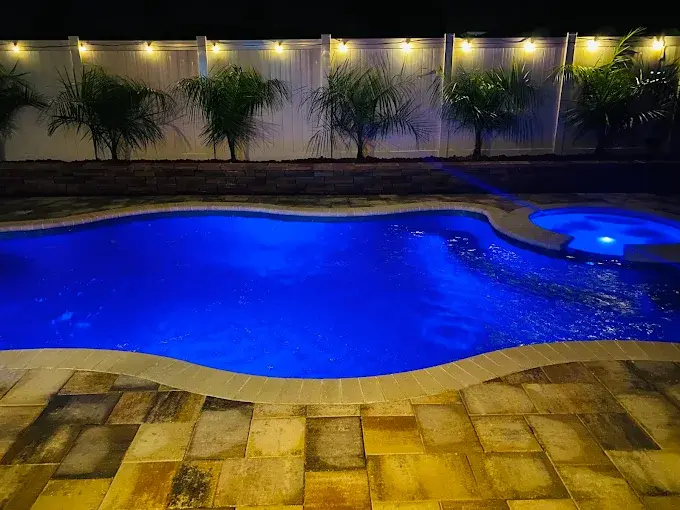
Paver decks, when installed with the right texture and finish, give far better traction underfoot than smooth poured concrete, especially once algae or mineral buildup starts to form over time.
We pay close attention to deck material and finish when a homeowner has mobility concerns, because most falls near a pool happen on the deck, not in the water. A textured paver surface, combined with a shallow entry and well-placed handrails, does more for everyday safety than almost any single feature added after the fact. It just makes more sense to plan for it early than to fix it later.
Noticed your pool deck getting a little slick, or maybe a handrail that's seen better days? Give us a call at (727) 843-0423, and we'll take a look before it turns into a real safety issue.
Screen Enclosures and Extended Comfort for Older Swimmers
A screen enclosure isn't usually the first thing people think of when accessibility comes up, but it plays a real role for older homeowners.
Keeping direct sun and biting insects out of the pool area means someone can spend more time outside without the discomfort that sometimes keeps older adults from using their pool as often as they'd like. It also keeps the deck cooler underfoot, which matters when bare feet are more sensitive to hot pavers than they used to be.
For homeowners who spend part of the year in Florida and part of the year elsewhere, a screen enclosure also keeps debris out of the pool during months when nobody's around to maintain it. That way, the pool is ready to use again as soon as the homeowner returns, instead of needing a cleanup first. It's a small thing, but it saves a lot of hassle come spring.
Designing the Whole Backyard With One Household in Mind
Accessibility works best when it's planned as part of the whole project rather than added piece by piece after the pool is already built. Our team designs the pool, the deck, and the screen enclosure together so features like entry slope, handrail placement, and deck texture work with each other instead of against each other. That's just how good design tends to work out.
That's why we sit down with homeowners early to talk through how the pool will actually be used, not just how it should look in photos. A design conversation that accounts for how someone moves through their backyard tends to produce a pool that still feels comfortable and safe ten or twenty years down the road, not just on the day it's finished. It's worth the extra conversation up front.
Have questions about accessibility features, or just want to talk through what would work best for your backyard? Contact us, and we'll help you figure out the right next step. You can also reach us at (727) 843-0423 or info@hawaiianislandpools.com. We're located at 6040 Main St, New Port Richey, FL 34652, and we're happy to answer any questions you have.
Related Topics:


Comments