
How Do Pool Builders in New Port Richey Manage Pool Construction Delays?

Building a pool feels exciting right up until someone mentions the word delay. Every homeowner we sit down with in New Port Richey asks some version of the same question, you know, what happens if the weather turns, if the permit office is slow, or if the crew hits something unexpected once the ground is open.
It's a fair question, and we take it seriously, because a pool project that drags on for months longer than promised is the single biggest source of frustration in this industry.
As a team that builds premier fiberglass pools in Florida, we've learned delays rarely come out of nowhere, honestly. They tend to show up in a handful of predictable spots, and a builder who plans for those spots ahead of time can keep a project close to its original timeline, even when Florida throws something unexpected at it.
Here's how our team actually manages that process, from the first shovel of dirt to the final walkthrough.
Why Pool Construction Delays Happen in the First Place
Most delays trace back to one of three things, really. Permitting takes longer than expected, the weather refuses to cooperate, or the scope of the project changes partway through because the homeowner adds a spa, a screen enclosure, or a paver design that wasn't part of the original plan.
None of that is unusual during fiberglass pool installation, and none of it has to derail a project if it's accounted for early.
What actually causes frustration isn't the delay itself, it's being surprised by it, plain and simple. A homeowner who was told their pool would be finished in four weeks and then hears nothing for six starts to lose trust in the builder, even if the delay had a perfectly reasonable explanation.
That's why we try to set expectations honestly from the very first conversation, rather than promising a timeline we can't actually back up once the ground is open.
How We Handle Permitting Before a Shovel Ever Touches the Ground
Every in-ground pool in Florida needs a permit, and the timeline for getting one approved depends on the county, the time of year, and how complete the paperwork is the first time it's submitted.
If you've looked into how long it takes to build a pool, permitting is usually the first big variable in that equation. We handle the entire permitting process ourselves, which means a homeowner never has to sit on hold with a county office trying to figure out where their application sits in the queue.
Our team knows the local offices we work with regularly, and that familiarity matters more than you'd think. We know what each office wants to see on a first submission, and we know which details tend to trigger a request for more information.
Submitting a clean, complete application the first time around is one of the simplest ways to protect a project's timeline before construction even begins.
Weather, Florida Summers, and Realistic Scheduling
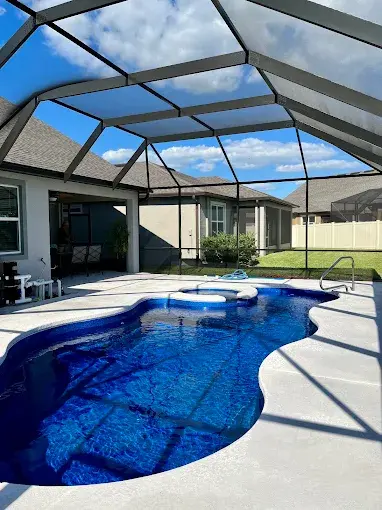
Florida weather is going to do what Florida weather does, and no builder can promise otherwise, not really. Heavy rain can push back excavation by a few days, and a named storm can push back a schedule by a lot more.
What we can control is how we plan around it, and honestly, that's a big part of choosing a pool builder who's upfront about scheduling. We build flexibility into every schedule instead of promising an exact date that assumes perfect weather for four straight weeks, because that assumption almost never holds up during a Florida summer.
We also stage work so weather delays in one phase don't automatically delay every phase after it. If excavation gets pushed back by rain, that doesn't mean the equipment installation or the paver work has to wait the same number of days, because our crews plan sequencing with a bit of built-in room to adjust.
It's a small operational choice, but it's the difference between a two-day rain delay and a two-week one.
Noticed your yard's still torn up longer than expected, or maybe you're just not sure where your project actually stands? Give us a call at (727) 843-0423, and we'll walk you through exactly what's going on.
How Communication Keeps a Delay From Turning Into a Disaster
The single biggest thing that separates a manageable delay from an infuriating one is whether the homeowner hears about it before they even have to ask. Reviewers who've worked with our team consistently mention being kept in the loop through every stage of their project, and that's really not an accident.
We check in at the points where something could realistically shift, rather than waiting for a homeowner to call and ask why they haven't heard anything in two weeks.
Our owner and our foreman are both directly reachable during a build, not tucked behind an office manager or a call center somewhere. When something does come up, whether it's a permitting question or a weather delay, homeowners get a real answer from someone who actually knows their project, not a generic update pulled from a project management system.
That kind of direct access tends to turn a stressful moment into just a minor inconvenience.
What We Do When a Delay Is Unavoidable
Sometimes a delay is just going to happen, no matter how well a project is planned. A permit office might sit on an application longer than usual, or a storm might roll through mid-build. When that happens, our approach is to be upfront about it right away, explain what caused it, and give a realistic new estimate rather than a hopeful one.
We'd rather tell a homeowner the truth about an extra week than promise a date we know is unlikely, just to dodge an uncomfortable conversation.
Most of the homeowners we've worked with say pretty much the same thing when asked about this afterward, that they didn't mind an occasional delay nearly as much as they would've minded being kept in the dark about it. Honesty about timing tends to matter more than the timing itself, really.
Frequently Asked Questions
Homeowners ask us some version of these questions on almost every project, so we're answering them here directly.
How long does a fiberglass pool typically take to build in New Port Richey?
Most of our fiberglass pool projects are finished in roughly four to five weeks from breaking ground to a swimmable pool, though the exact number depends on permitting, weather, and how much additional work like a screen enclosure or paver deck is part of the project.
What causes the most common delays in pool construction?
Permitting timelines and Florida weather are the two biggest factors. Scope changes partway through a project, like adding a spa after construction has started, can also add time.
Do you handle the permitting process for us?
Yes. Our team manages the full permitting process with the local county office, so homeowners don't have to deal with that on their own.
Will bad weather stop our project completely?
Rain and storms can push back certain phases, especially excavation, but we stage the project so a delay in one phase doesn't automatically delay every phase after it.
How will we know if something is running behind schedule?
We check in proactively at the points in a build where a delay could realistically happen, rather than waiting for you to reach out first.
Can we still add a spa or screen enclosure after the project starts?
It's possible, but adding scope mid-project is one of the more common reasons a timeline shifts. We'd rather talk through the full design upfront so the schedule reflects everything from day one.
Contact Us
Our expert team is here to help you create your dream backyard oasis. We take pride in our exceptional customer service, high-quality products, and expert craftsmanship. Let us help you make your pool and spa dreams a reality! Our office hours are Monday through Friday, 8:00 AM to 5:00 PM.
Address: 6040 Main Street, New Port Richey, Florida 34652
Phone: (727) 843-0423
Email: info@hawaiianislandpools.com
Contact us using the form or call us directly for any inquiries about our pool and spa services.
Related Topics:


Comments